Showing posts with label countertop appliance. Show all posts

Tuesday, January 29, 2019

Renato's Brewing System for Coffee, Tea, and Espresso

Anyone who knows me would tell you that I'm a total freak for gadgets. I adore cooking gadgets most of all, but I can get a little giddy about a new lawnmower or power tool, too. When someone sends me a new cooking gadget to test, I'm happy as a clam.

How happy are clams, anyway? Has anyone heard a clam laugh, or even giggle?

I like testing new gadgets even if I already have something similar, and even when the gadget isn't the perfect fit for me or my kitchen. It's just so much fun to set them up and see how they work. Wheeee!

So when I got an email about Renato's new brewing system that's just now on Kickstarter, I ignored the perfectly find coffee maker on my counter. And that other one stored in the garage. And ... well, there might be one more. Does a French press or espresso pot count? Nah, I don't think so.

But I ignored all those and said, sure, send me this thing.

And they did. And they sent pods, because it's a pod-eating device.

Okay, so it doesn't actually eat the pods, but you insert them in the machine, and they disappear. Later, they emerge in the discard container where you can leave them pile up until it's convenient to dispose of them.

It's different, that's for sure. No need to remove the used pod right after brewing.

I really liked the design of the thing. It's a square box-like device and most of what it does is hidden from view. You see a few buttons and the place to set your cup, and you see the liquid coming out, but that's really about it. It's clean look, in shiny black.

It makes three sizes of beverages. One is and espresso shot. One is espresso lungo. And the third doesn't really have a name yet, but it's a larger amount, like you'd use for brewing tea (they sent me green tea, but they have other options, as well.)

Since what I got was a prototype, the manual left out a few bits of details, and a few things were a little fiddly, but I've already been told that all of those are going being buffed and polished before the final units ship. But first, they're raising funds on Kickstarter. So you get your chance to order one of these things for your very own kitchen.

One downside to this device is that you need the proprietary pods, but they say that they're cheaper than those other guys who make pods. To be honest, I haven't compared prices, but it seems like people either love the convenience of pods or they refuse to use them. There doesn't seem to be much middle ground. So, this uses pods. You drop them into a hole, push down the lever that's over the hole, and you choose your size of brew. And off it goes, sending coffee or tea or espresso right into the cup that you remember to set under the spout.

Or, it goes into the drip tray because you forgot the cup and you grumble.

Grumble, grumble.

There's a swing-around tray that holds smaller cups closer to the spout, or you swing that around to give you room for a larger cup, like if you're going to fill a cup with steamed milk, for example, and it's not going to fit in that shorter space.

The water reservoir seems like a reasonable size. Big enough so you can brew a lot of shots before you have to refill, but not so huge that it's taking excess space. The reservoir removes from the unit for easy filling and washing, but since it's just holding clean water, it shouldn't need a ton of attention. The drip tray and the container for used pods pulls out so you can empty and clean those.

So, should you kick-start this thing?

I have to say that the espresso I brewed was good (as was the green tea) and it was super-simple to use. Since the pods disappear, you don't have to remove and replace them with each brew, so you can just keep adding pods and brewing more coffee if you're serving a bunch of people. So that's convenient. Of course, you eventually have to empty it, but it's all in one place so you just dump it into the trash, give it a rinse, and you're back in business.

I received a prototype to test at no cost to me.

Tuesday, December 11, 2018

Cosori Multi Cooker

I had a multi-cooker years ago, and I loved that darned thing. It was the replacement for a slow cooker, but it could also saute prior to cooking, which was totally awesome.

Eventually, it got shoved to a corner of the counter and finally it moved itself into storage when the pressure cooker invasion began. Sort of like the British invasion, but without shaggy hair and guitars. I started loving the idea of quick cooking, and they could slow cook when I was in that mood.

Then, I started missing it, because some things just don't fit well into a pressure cooker. So, when the nice folks at Cosori offered me a unit to test, I said yes.

I wasn't familiar with the brand, but after checking reviews online, I saw that users liked their products, and the features looked pretty good. The multi-cooker looked like it was solidly built, and when it showed up it looked like a quality product.


One thing that puzzled me was that the gasket that fits around the lid was not installed, but then it made sense. Users should remove the gasket to clean the lid completely, and having it packed separately makes it obvious that it can be removed and replaced easily. Kind of a smart thing to do.

This critter has a much slicker, shinier, more modern look than the one I had before, One knob selects the type of cooking and the other knob selects time and temperature. There are buttons to start or cancel the cooking process, to select time or temperature to be adjusted, to set the delay timer to start later, and to keep the food warm.

One nice feature is that the handles on the cooking pot have silicone covers, so they're not as hot as screaming hot metal. I'd suggest using pot holders, anyway, when you're removing a hot cooking pot, just to be safe.

First I tested the simmer function using plain water, and it was a nice, perky simmer. I steamed, roasted, and slow cooked, too. I haven't yet baked anything, nor have I made rice or yogurt, but I'm sure those functions are fine, too.

Overall, this is a really nice cooker. The shape is nice, so you can get a roast or a chicken in there, and the cooking pot is nonstick, so it's easy to clean. This came with a chrome-plated rack that fits the pot. The rack has reasonably tall handles, so you can get it out of the cooker easier, even if you've got liquid in the bottom of the pot. I used the rack for steaming and roasting.

Why yes, I did get to test this for free!

Monday, October 15, 2018

Quick Peek: Ninja Foodi

Ninja has made some innovative products, and I've reviewed a few of them over the years. Their slow cooker was on my kitchen counter for many years, and their blenders are real beasts.

The latest from Ninja's warped mind is the Foodi. As soon as I saw it, I pre-ordered the danged thing because I just had to try it. I had to.

And then I waited for it to show up.

And then it arrived. I had the box ripped open and it was on my counter running through a test before the delivery guy had gotten to the end of the block. puff, puff

The Foodi is the mutant stepchild of a pressure cooker and an air fryer. Yeah, you heard that. It pressure cooks AND it air fries.

That's why I had to have it. This is a new category of product, and it actually makes sense.

I've owned pressure cookers of all types, and I use mine regularly. Air fryers, though ... I've used them, I've liked the results, but I never loved them enough to keep them on my counter top long term. The idea of combining an air fryer with a machine I use often just made sense.

I did a quick pressure test to make sure the pressure cooker function was working correctly, then I browsed through the recipe book that came with the machine to see what I could make right away. I settled on potato wedges because I had a bag of potatoes and I knew I liked them in an air fryer.

The instructions were a little different than what I made in the air fryer. These were pressure cooked for a short time, then I drizzled on some oil, and then I air fried them. The result was very much like what I'd gotten from the previous air fryer, but faster.

The cooking bowl of the Foodi is wider than any of my other electric pressure cookers - a bit over 9 inches in diameter - so it will fit larger accessories and larger hunks of food, as long as they're not super tall. And for sure it can hold more than the air fryers I've used, so that's a bonus. It also seems to be willing to work with less liquid than some pressure cookers I've used. For the potatoes, I only needed 1/2 cup of water, which isn't much at all.

I'm kind of curious about that wide bowl, particularly for cooking cheesecakes. I've made cheesecakes in my other pressure cookers before, but they were pretty small, since larger pans wouldn't fit. With this wide pan, I can fit at least an 8-inch springform pan, and possibly even a 9-inch pan. I guess I'll be experimenting with cooking times.

Besides the machine and the nonstick cooking pot, this comes with a "cook and crisp" basket that I used for the potato wedges. And I have to mention that the potatoes got brown and crisp on both the top and bottom. It also includes a rack that can be used in two different ways, either as a steaming rack to keep food low in the cooking pot, or as a broiler rack, holding the food close to the top where the heat is generated.

It has one lid that's permanent - that's the air fryer lid. And there's a removable lid for pressure cooking. When you use the pressure cooker lid, you simply flip the fryer lid up.

I plan on doing some more testing with this, but I wanted to give you a heads-up on it, since it's so new and weird.

So far, I like it. Next, I'm going to try some chicken. There is a recipe in the book for a whole "roasted" chicken that is first pressure cooked, then air fried, and that's kind of fascinating. This could also be great for ribs, since they could be pressure cooked, then slathered with sauce and air fried or broiled.

I haven't tried all the buttons yet, so I'm not sure how they all function. Unlike many of the electric pressure cookers that have buttons for everything from cake to poultry, this doesn't have presets for different foods. And that's fine with me. I seldom use the presents on my pressure cooker.

When you're ready to press buttons, this senses whether the fryer lid is in place or not, and the cooking options change based on that. If you're already cooking with the fryer lid in place, the lid will turn itself off while you check the food. Then it turns on again and cooking resumes when the lid is down again.

But back to buttons ...

With the fryer lid down, you have options to air fry, bake/roast, or broil. With the fryer lid lifted, you have your choice of pressure cook, steam, slow cook, and sear/saute. It won't actually pressure cook without the lid, but the settings are there. Up and down buttons let you change the temperature and set the time. There's also a keep warm function, a start/stop button, and a power-off button.

So, yeah, I have a lot of testing to do. Lots of buttons to press. But first, I need to buy a chicken.

I bought this. Nada freebies.

Note: as I'm writing this, Amazon only has these from third-party sellers at a considerably higher price than I paid. Wait until the price comes back down if you're as crazy as me and you need one of these.

Tuesday, December 5, 2017

Dash Rapid Cold Brew System

I've fallen in love with cold brew coffee. It's smoother, not as bitter, and seems to be less harsh on my tummy. It makes cheap grocery store coffee taste good, and when I spring for the good beans, it's swoon-worthy.

I like to make the cold brew extra-strong, so I can add it to hot water to have drinkable coffee in the morning. Sure, sometimes I'll have iced coffee, but most of the time, I prefer it hot.

So when I got an email offering me the Dash Rapid Cold Brew System, I was very curious. When I make cold brew, I set it up in the evening an let it steep all night. The Dash system makes cold brew in 15 minutes or less.

What kind of sorcery is that?

Of course I asked for a review unit, and set it up right away. I ran plain water through it first to see how it worked.

Very eeeenteresting. *mustache twirling optional*

The device pumps water through the grounds rather than just letting the water sit and steep. It goes from the carafe to the grounds and then back into the carafe. What you end up with is cold brew coffee that has been agitated to release more flavor in much less time.

There's a timer that you can set for up to 15 minutes, but if you haven't reached the right strength, I don't see any reason why you couldn't start it over again for another round.

The pump on this is a little noisy. Not as noisy as a blender, but it definitely makes more noise than the pump on something like a desktop waterfall or my Aero Garden. But of course, this isn't meant to be soothing, and it's not on for a long time. Just long enough to make the cold brew.

I've used this several times now, making larger batches to store in my fridge so I can make my usual hot coffee. I haven't yet found exactly the right ratio of coffee to water to the most concentrated brew, but I'm getting close. For someone who doesn't want concentrate, it's just a matter of adjusting the ratio to make your preferred drinking strength.

I have to say that it's nice to be able to make the coffee so fast. There have been a few times I've forgotten to set up my overnight brew, which led to a sad, coffee-less morning. Now, the worst that can happen is a 30-minute wait.

Since the brewer pumps both clear water and coffee, I've been cleaning it between brews by running clear water through it. One cycle seems to be enough, but if it was putting it into storage, I'd probably do two brews for more complete cleaning, so there would be no coffee residue at all.

This takes about the same amount of space as my other cold brewer, although it's a different shape, and it's smaller than many standard coffee makers. On the downside, it requires electricity. Not a big deal, but you still need to set it up somewhere near an outlet. Since it's relatively small and lightweight, this is easy to move around or store.

Overall, I like this a whole lot more than I expected. And I like the idea that if I want a quick cup of afternoon cold-brew decaf, I can have it ready to drink in a very short time.

The Dash Rapid Cold Brew System is available at Target.

Who's it for: Pe0ple who drink coffee and prefer cold brew.

Pros: Yay, it works!

Cons: It's a tad noisy.

Wishes: With appliances in the kitchen that are made in so many colors, this one is only available in black. For now.

Source: I received this from the manufacturer for the purpose of a review.

Sunday, December 3, 2017

Housmile Electric Pressure Cooker

I've owned quite a number of pressure cookers, including both stove top and electric, so when Housmile contacted me and asked if I wanted to test theirs, I figured it would be pretty easy to put it through its paces.

I mean, I've used so many different ones, this couldn't be too hard, right?

So let's look at that front panel, shall we?

It has a warm/cancel button, a pressure setting button, and presets for rice, cake, soup, bean (hopefully not one at a time), porridge, fish (in a pressure cooker? I think not), ribs, and poultry.

There's a Time Preset button in the center, with plus and minus buttons.

The plus and minus made sense, but I had no idea what the time preset was. Turns out, it's for setting a time delay. So you can throw stuff in the pot and have it start at a later time. But it only works with certain presets, because throwing meat in there and leaving it at room temp for many hours would be a spectacularly bad idea.

There's also a "Taste" button with selections for hard, perfect, and soft. I figured that was for rice.

What was missing from this layout was anything said manual - you know, for setting pressure and time manually. If you do want to set something aside from the presets, you can choose one of the presets and then change the cooking time.

Aha! After some fiddling around, I figured out that the Pressure Setting button didn't actually set pressure to high or low, as many electric pressure cookers do. Instead, it sets the time for pressure cooking when you're not using a preset. So this is the manual time setting for pressure cooking at whatever pressure it cooks at.

The box as well as online information claims that this cooker can slow cook and saute, but there are no buttons for those functions. The instruction manual is very sparse, and didn't include any information about how to invoke those functions, so I decided to do more testing to see if I could make magic happen.

I found out that I could press a preset and the cooker would heat up without the lid on. Okay then, that's one way to get it to get it to brown some foods. I didn't test all of the buttons to see if they'd ALL work with the lid off, but it's an easy experiment if you own this pot. If I was going to live with it long-term, I'd test all the buttons to figure out what temperature each one reaches for the best saute.

As far as slow cooking, since it doesn't need the lid on to cook, you could test the presets to see if any of them would cook at a simmer. Or you could put the lid on and leave the steam release open so it can't reach pressure. It might not be a slow cook, though, if the cooker is trying to reach pressure.

But really, most people who have a pressure cooker don't bother with slow cooker functions, anyway. Maybe it's not all that important? But since the box and online information say it can slow cook, I wish there would have been better information on how to make that happen. If it can happen. I'm really not sure.

The Housmile pressure cooker page on Amazon describes the inner cooking pot as "Healthy, aluminium alloy inner cooking pot made from food grade 304, no chemical coating," which isn't accurate. First, "grade 304" refers to a grade of stainless steel rather than aluminum. And second, while the pot is made from aluminum, it has a nonstick coating. Which makes sense because cooking in an uncoated aluminum pot wouldn't be a good idea. I have a feeling they copied and pasted some of this from another one of their models and didn't check it for accuracy.

There is also a 1000-watt Housmile pressure cooker on Amazon that has more functions and might be a better buy for people who don't want to experiment with settings. I haven't tested that one, and I have no idea if the instructions are better, but just the fact that the buttons are more logical makes it more appealing to me if I had to pick one of the two.

Overall, this works well enough. I used it to make stock and to make soup, and it performed pretty much like I expected. But it would be a much better product if the instruction manual was complete, or if the company's website or Amazon information had better instructions. People who don't want to experiment or who aren't familiar with this sort of cooking appliance are no doubt going to be frustrated with scant information provided.

One thing I really do like about this is how easy the lid seals. It's not quite as clunky as other cookers I've used. The pressure release is also quite nice, since you press a button and the steam releases at a valve that's a little distance away.

Whether that's enough to make up for the lack of instruction ... you decide.

Who's it for: People who want a pressure cooker.

Pros: Nice lid and pressure release functions.

Cons: Instructions are lacking.

Wishes: This seriously needs a saute button and a slow cook button if it's supposed to have those functions. Also, I'm still not sure if it uses different pressure settings and/or different temperatures for different cooking functions. That would be useful to know, since there isn't a manual way to set both time and pressure level and since there are no saute or slow cook functions on the control panel.

Source: I received this from the manufacturer for the purpose of a review.

Wednesday, October 25, 2017

Vita Clay Multi Cooker

This review took quite a while to get written, because I wanted to be as thorough as possible. I didn't want to cook one or two recipes and go on my merry way without answering some important questions.

And those questions took time to answer. So ... I've been living with this on my counter for months.

The Vita Clay company makes slow cookers and rice cookers with a twist. Instead of a metal cooking pot, the Vita Clay appliances have a clay pot. Crockery. Without a glazed coating. So ... completely different from everything else on the market.

Or anything else that's an electric appliance. There are plenty of clay cookers for oven and some that are good for the stovetop as well.

One of the biggest questions was whether the clay would absorb flavors and odors that would then transfer to other foods. The surprising answer is no. I've cooked everything from pork and sauerkraut to chili to soup in my cooker, and I've also cooked plain white rice after those more pungent foods. And ... there's been no transfer of flavor.

Honestly, I was surprised by that. I expected to have to tell you that you shouldn't cook your yogurt after cooking your kielbasa surprise.

The other surprise was that the clay pot was much easier to clean than I expected. Even with foods as sticky as rice can be, I was able to wash the pot easily afterwards.

There are some downsides to this cooker. You've got a clay inner cooking pot and a clay lid. If you're a klutz and you drop it, it's going to break. If you're not in the habit of dropping your other cookware on a regular basis, you should be fine. There's also some risk of thermal breakage, so you shouldn't take out the hot inner pot and put it on a cold surface. Also, the pot shouldn't be stored while it's still wet or damp, so you need to let it dry completely before putting it back into the cooker and closing the lid.

Cooking in this is much like any other slow cooker or rice cooker, with a couple of exceptions. For one thing, since the clay is porous, you'll loose a little more moisture than when you're cooking in a similar device with a metal pot. If you've ever made a soup or stew in a slow cooker and wished that it wasn't so thin and watery, you'll love that the liquid disappears a bit more in this cooker. In that sense, it's similar to cooking on the stove.

It has a buttons for different foods (rice, soup, stew, yogurt). I was quite surprised at how short the cooking time was for the soup and stews, so you shouldn't plan on putting food into the cooker before you go to work unless you've got some kind of super-tough meat. On the other hand, it would be ideal for unattended after-work cooking. Think of it as a stovetop replacement rather than a slow cooker, and you've got the idea.

The rice was also a success. I tried both white rice and brown rice, and both turned out perfectly. There's also a special button for reheating rice, in case you want to make a lot in advance and reheat as needed.

I haven't tried the yogurt, but I'm pretty sure that will be just fine, too, based on everything else I've made.

Who's it for: Great for people who want a countertop appliance for cooking, but prefer more natural cooking vessels.

Pros: Works well, foods cook quickly and aren't watery as can happen with slow cookers or pressure cookers.

Cons: The clay insert is breakable and it needs a little more care than a teflon-coated metal pot. Good news is that there are replacements available.

Wishes: Since this is really different from a standard slow cooker, it would be great if there was a larger cookbook with recipes (it did come with a recipe book, but more is always good.) While I'm pretty adept at creating and adapting recipes, some folks might appreciate more recipes to get the most use out of the cooker.

Source: I received this from the manufacturer for the purpose of a review.

The Vita Clay folks make a pretty large variety of appliances. Some are better for rice, so if that's a priority, make sure you pick one that is designed for that use.

Wednesday, August 2, 2017

Yonanas

Yonanas with cherries!
You might have heard of Yonanas. I certainly knew the concept before I was sent a unit to test. You freeze bananas and you run them through the machine and you end up with something that's the consistency of soft-serve ice cream but that is 100 percent bananas.

Well, it's 100 bananas until you start adding other things. I tried both frozen cherries and frozen pineapple and I ended up with something like a sorbet. And then I tried them mixed with banana. There's a cookbook included with even more ideas, and not all of them are desserts. And some are pretty surprising.

Yup, Yonanas isn't just for bananas.

But then again, Yonanas is named for bananas, so ... the key to the perfect Yonanas banana is to make sure the bananas are speckled with brown before you freeze them. This makes sure you get something with the right texture and some sweetness. Freeze the bananas too early and, since cold dulls the sweet flavor, you get something that's not very sweet at all.

Of course, that doesn't mean you can't stir in some honey or maple syrup or chocolate or a pinch of salt. I also mixed banana with yogurt to add more of the dairy "feel" to the dessert.

The Yonanas machine certainly isn't a must-have item, but it's fun. And since the blades are deep into the machine, it's pretty safe for kids to use. Since the food dispenses into your bowl or cup, kids don't need to pour or scoop as they would with something like a blender or food processor, so they're less likely to make a horrendous mess.

Adults should be in charge of taking it apart for cleaning, which is pretty simple. Parts just twist off and you can get to every surface to do the cleaning, then put it back together so it's ready for the next use.

The one cleaning tip I have is that it's smart to remove the mechanism from the machine right after you're done. I left mine unattended while I sampled, and as the frozen residue melted, it dripped on the counter and dripped even more as I took it apart. Not a major disaster, but it doesn't drip at all if you deal with it right after using.
Photo courtesy of Yonanas

After I was done testing the yo-machine at my house, I brought it to my neighbor's house to give it a test run with my faux-grandchild.

They unboxed it immediately and grabbed some frozen fruit they had on hand. Mixed berries and mangoes went into the maw of the machine. The little man, with a tooth or two not yet emerged, was delighted.

What sorcery is this?

While I was there, they brainstormed what else they might throw into the machine. Frozen peas, perhaps?

Oooh, how about cooked carrot sorbet? 

I left the machine with them to see what the longer-term review would be, and so far it's been a big hit. Unlike throwing fruit into a blender where you need a certain quantity for optimum blending, this can make small, baby-sized single servings. Which means it can be a different flavor each time. Or obviously you can keep throwing fruit into it for bigger adult-sized servings. It's easy to clean. The result is super-healthy, since it's just fruit. And the little guy loves it.

Who's it for: This one has two major markets where I think this hits the sweet spot - families with babies and kids, and also dieters who want to make sweet, simple, small desserts on the fly. Of course, non-dieters who crave slushy fruit desserts would also like it, but the kid market is probably where it's most useful.

Pros: Works well. Flavor options are endless. Easy cleaning. Great for kids. Littlest kids can eat it, and older kids can use it to make their own desserts. And everyone can have a different flavor.

Cons: It's another countertop appliance that will compete for space. Fortunately it's small and lightweight so you can find space for it in cabinet or in the pantry, but households with kids might find themselves using this daily. Move over, coffee maker.

Wishes: A slightly wider feed tube might be nice. But if it's being used by kids, I can see why you wouldn't want it too large.

Source: I received this from the manufacturer for the purpose of a review

Tuesday, August 30, 2016

Salton Frozen Dessert Maker (But wait! It does more!)

When the folks at Salton offered me a frozen dessert maker to test, I almost said no.

And then I waffled.

I've seen the frozen dessert makers where you shove a frozen banana into the maw of the machine and frozen banana "ice cream" comes out the other end. I was vaguely intrigued by them, but not enough to buy one. I like room temperature bananas just fine. And I'm not afraid of regular ice cream.

But when I saw that the Salton machine was not a one-trick pony, I decided to give it a try. You see, it also works as a grater and slicer - there are five grater cones for coarse, fine, and extra-fine grating as well as thick or thin slicing.

I tried the frozen banana dessert a few times and I have to admit that it wasn't bad at all. A banana-peach combo was pretty good. It would be great if you're cutting back on dairy or trying to avoid ice cream. It's a nice cold dessert if you want something light. I think I'm going to buy some strawberries and give them a try if I see some good ones at the store.

But let's talk about this grating. There are times when I need more cheese than I want to grate by hand, but not so much that I want to set up the grater on the food processor. Not that it's a big deal to set up the food processor, but then I have to wash the bowl, the lid, the pusher, the grater thingie...

With this little machine, there's just not that much to wash. And the machine itself is pretty small, so it should store easily, too.

I had a little trouble assembling it the first time - the way the tube fits onto the body of the machine feels like it's off-kilter, but once I figured it out, it wasn't a problem. It's a little noisy when it's running, but that's not a big deal either. This isn't a machine that's going to run for long periods of time - you're going to torment your bananas or shred your cheese, and that's the end of it.

I haven't had this long enough to guess how long it will last, but it seems sturdy enough for what it's meant to do.

Note: In the photo, I've got the mouthpiece of the shredder unit upside-down, but it still worked fine. That piece isn't actually needed, anyway.

Who's it for: Gadget lovers. Or people who want to avoid ice cream but want cold dessert.

Pros: Does what it's supposed to do. Small enough to store easily. Grater!!!

Cons: Not a necessary device in the kitchen.

Wishes: I wish the all the pieces could all store together in one neat package. I'll probably store it in its box to keep it all together.

Source: I received this from the manufacturer for the purpose of a review.

Tuesday, August 23, 2016

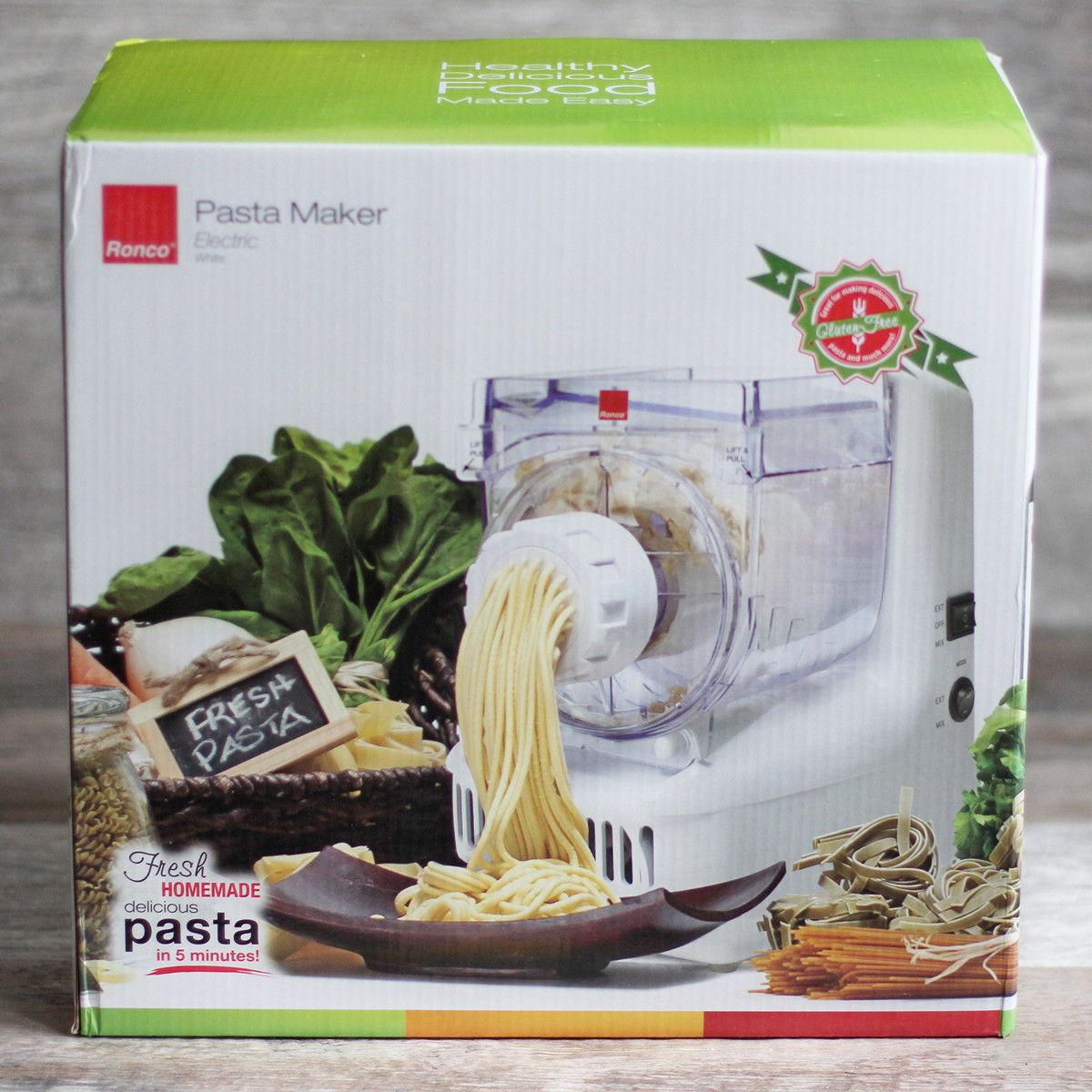
Ronco Pasta Maker

I've been wanted a stand-alone pasta machine for some time, so when the folks at Ronco offered me a product to review, I checked out their website and said, hey, how about that pasta maker instead?

Yup, Ronco makes a pasta maker.

I mean, what the heck. Might as well play with something I'm curious about, right?

Here's the thing. I've got a pasta attachment for my stand mixer, so in theory I could use that. And I do, sometimes. But I've always thought it would be interesting to have one machine that would do the kneading and then just extrude the pasta. One thing to clean.

So, the pasta machine arrived and I took it apart, washed it, and put it together again. The first time I assembled it, I had a little trouble figuring out which part went where, but now that I've done it a number of times, it's really pretty simple.

I took it for a test run at home, then brought it to a friend's house where we made pasta from some freshly-milled flour along with all purpose flour.

My first impression of the machine was that there was a lot of plastic. Would it hold up? Pasta dough has to be pretty dense, particularly for extruded doughs. For some reason, the extruding process always makes the dough a lot softer (not just this machine, but my other extruder as well), and the dough tends to stick together. So ... the starting dough needs to be pretty tough to start off.

The mixing chamber did seem to flex a bit, or maybe it's just that I was mesmerized at watching it knead. But it held up. Flexing is better than cracking. The motor didn't seem to strain at all, so that's pretty impressive.

I have no idea how durable this machine will be over the long run. For now, it's working fine, but I've only made about a half-dozen batches of pasta in it. The motor is a tad noisy - not as loud as a blender, but not as quiet as a stand mixer, but this isn't a machine that's going to be running all the time, so the noise isn't a deal-breaker.

The controls are simple. Flip a button one way and the dough gets kneaded. Flip the other way, and the screw-like kneader spins in the opposite direction, to feed the dough through the extruder. It's ingenious, really.

The machine comes with a variety of extruding dies (spaghetti, fettuccine, rigatoni, linguini, and lasagna) for different shapes of pasta.  I haven't tried them all yet, but the ones I tried worked just fine. There's also a tube that's used when you want to fill sausage casings with sausage, so this isn't a one-trick pony. Two tricks, basically.

Speaking of tricks, making fresh pasta can be a little tricky. To start with, you have to get the dough the right consistency, and you have to let it knead long enough. That's something that comes with practice.

But then there's the cooking. Fresh pasta cooks really really really fast. Like, it sees the hot water and it's done. The last batch of pasta I made was beautiful coming out of the machine, but I made the mistake of turning my back on it when it was cooking, and I overcooked it. To death.

Not at all the pasta machine's fault. Just poor attention span here. Oopsie.

Who's it for: Pasta people.

Pros: It's one machine for kneading and extruding pasta. Flour and water are really cheap ingredients, so you can afford to make some test batches and if they don't work, you haven't wasted a lot of money. Then when you get good at it, you can add a more expensive item. Like an egg. Splurge!

Cons: It takes a little practice to get the recipe right. Not the machine's fault, but it might take a few batches to achieve perfection. It will take even more practice if you decide you want to add extra ingredients to the pasta, like tomato, basil, squid ink, saffron, or anything else. But, hey, it's fun.

Wishes: An integrated cutter for slicing the pasta into desired lengths as it exits the machine would be great. I use a knife, swiping from bottom to top, and it works fine. But a cutter would be awesome.

Source: I received this from the manufacturer for the purpose of a review.

Tuesday, May 17, 2016

Novis Vita Juicer

I've reviewed a whole lot of juicers. Some are slow, some are fast. Some eject the pulp. some don't.

But most juicers are for juicing vegetables, pit-free fruits, and greens. Until now, juicers weren't of much use for citrus fruit.

I mean, you could certainly peel an orange and toss it into the maw of a regular juicer. But that's kind of troublesome. And messy.

So, if you wanted to juice lemons, limes, oranges, or the rest of their relatives, you had to press or ream them manually, right?

I have squeeze-type juicers and several types of reamers, and they work fine. Or let's say that they're fine when I only need a few limes or lemons. When I'm making key lime pie or I need a lot of juice for curd, manually juicing citrus isn't a lot of fun.

But now ... NOW! There's a juicer that does that regular juicing, but quickly switches to let you power through citrus - the Novis Vita Juicer. Well, it doesn't switch - you switch a few parts and you can juice citrus - and you can control whether you want your juice pulpy or not.

This is kind of a game-changer. Well, it's a game changer if citrus-juicing is something you do. Lemon curd is soooo much easier with this machine. So much. I'll probably juice more citrus just because it's easier to do.

Juicer with citrus attachment.

I tormented a bunch of different fruits and vegetables, and I was really pleased with the juicing results. I was also very pleased when it came time to clean the juicer. Unlike similar juicers that have a bowl-like centrifuge-thing (I have no idea how else to describe it!) this bowl-thing has a bottom that comes out, which makes it a LOT easier to clean. A lot. It's genius.


Citrus reamer attachment.

When it came to citrus, I was surprised at how little was left behind in the skin. This is great when you want a pulpy juice, but also when you want just the juice without the pulp, since you can let the machine strain the juice for you.

Best thing, though, was that when I was juicing a lot of oranges, I got a LOT more juice than if I just squeezed them by hand.

Nothing left here - all the juice and pulp is gone!

Who's it for: People who juice and want a better way to handle citrus, too.

Pros: Works well, Juices pretty much anything I want to juice. Lots of colors to choose from.

Cons: Pricey. But all high-end juicers are, so ...

Wishes: I keep thinking, well, what else could it do? But I'm stuck. It's a juicer. It juices.

Source: I received this from the manufacturer for the purpose of a review.

Tuesday, May 3, 2016

Salton Easy Bread

If your pod-style coffee maker and your bread machine romanced each other, the result might be something like the Salton Easy Bread. It's a bread machine for people who want the easiest process possible.

It couldn't possibly be easier than this, unless your neighbor baked a loaf of bread and delivered it to you.

The concept is just like coffee machines, where you have your pre-measured coffee in a capsule or pod.

But in this case, you have capsules that contain bread ingredients - flour, yeast, salt, flavors - that you insert into the machine.

The machine pierces the capsule and the ingredients fall into the machine's mixing/baking bowl. There's a water container at the back of the machine - just like on your coffee machine - and it dispenses measured water into the bowl.

Buttons on the front of the machine let you select a few basic things - like whether you want a light, dark, or medium crust - but other than that, it's all pretty automatic. When the bread is done, you open a tray in front, remove the bowl, and flip the bread out. Just like a regular bread machine.

There are quite a few different types of bread mixes available, ranging from a basic loaf to one that's super-seedy and rustic. I've tried most of them, and they're all good.

The loaves aren't as large as my other bread machine, but that's really not a problem. These are easy enough to make that folks could make a new loaf every day, if they wanted to.

Who's it for: People who want a really easy way to bake bread.

Pros: Easy. Very easy.

Cons: While there are a number of different types of bread, it's not infinite.

Wishes: Make-your-own pods would be awesome. I could assemble my own recipes, store them, and when I want to bake it would just be really simple.

Source: I received this from the manufacturer for the purpose of a review.

Monday, February 29, 2016

Le' Cook Spoonula

I get tons of emails from people asking me to write about their Kickstarter projects. Mostly I say no, because it's hard to have an opinion about something I haven't actually seen or used. Some things look good in concept, but the execution isn't that great.

This time, though, I got a chance to get my hands on the product while it's still on Kickstarter. And as soon as I saw it, I wondered why it took so long for this to exist.

The Le' Cook spoonula is a silicone spoonish-spatula with a hook. Literally. A hook that lets you hang it on the edge of a pot.

That's it. That's the concept. And it makes so much sense. If you want to leave the spoonula in the pot, you can. If you want to hang it, you can. If you take it out of the pot, the hook keeps the spoon-end off the counter.

Speaking of the spoon in spoonula, this isn't a deep spoon. You won't be using it to serve soup. But it's got a gentle curve to it that makes is spoonish rather than a flat spatula.

Who's it for: People who stir things when they cook. Seriously, it's a basic item.

Pros: Simple concept that actually works.

Cons: Like any startup these are more expensive than what you'll find at the dollar store bargain bin.

Wishes: I imagine they'll make more styles eventually, so I won't even mention that.

Source: I received this from the manufacturer for the purpose of a review.

Friday, June 5, 2015

Coffee Maker 3.0

Very recently, my beloved Breville single-cup coffee brewer started exhibiting strange behavior. It was making peculiar sounds and it was dispensing less and less coffee with each brew.

In a fit of do-it-yourselfishness, I watched a few YouTube videos and decided that a filter was clogged and I could fix it.

How hard could it be? I used to fix computers for a living.

I unscrewed a bunch of screws, took out the filter, cleaned it (and there were little bits of stuff in there that looked sort of like very fine coffee grounds) and put it all back together.

I reassembled it, filled the water tank, plugged it in, and pressed appropriate buttons.

It spewed a little bit of water, and then nada. No more water pumping at all.

I took it apart several more times, trying to figure out what I had botched. I watched more YouTube videos and followed more advice. Then the menu buttons didn't work. That wasn't an improvement.

The next morning, after drinking some instant coffee, I toddled off to find a new machine. Most of them proclaimed that they only worked with Keurig cups. Nope, that's not going to do. I like using my own ground coffee and sometimes I get samples of non-Keurig brands of coffees and teas.

When I can afford the really good ground coffee, I splurge. Otherwise, the cheap stuff will do - and that's a heck of a lot cheaper than those K-Cups, so it's very budget-friendly.

I had a couple of choices of coffee makers, and picked a mid-priced machine that looked fairly sturdy. When I got home I set up and tested the machine - a Mr. Coffee model - by running water through it - and hot water came out of it. It took quite a while for the water to heat and the water to dispense, but it wasn't a super-expensive machine, so I figured it wouldn't kill me to be a tiny bit more patient in the morning.

I wasn't planning on drinking more coffee that day, so I let it rest until the next morning.

But then I thought, gee, I like those folks at Breville and every product of theirs that I own has been really solid. Even the coffee maker. Other people complained that their Keurig machines were lucky to last 6 months or a year, but I'd had the Breville for ... well, a long time.

I wasn't looking for a replacement machine, but I thought Breville might have some tips on fixing the problem. They did have a troubleshooting page on their website, but it didn't have any more information than the videos I watched. And we know how helpful those were.

I chatted with a very friendly person at Breville who gave me a few tips, but finally we concluded that the pump must be malfunctioning or some other deep internal thing had gone bad. Which makes sense. It pumped a lot of water over its lifetime without any problems.

She said that the model I had was discontinued "several years ago" and that even the newer model of single-cup brewer had been discontinued for some time. See, I told you my machine was old.

So, she couldn't offer a direct replacement, but she did offer a discount on anything else of theirs that I might want to buy. Anything else ... not just a coffee maker. That was a pretty good offer. Unfortunately, they only had full-pot coffee brewers, and I needed a single cup model.

Oh well. At least I had Mr. Coffee to keep me company in the morning.

I joked with my husband that I had fixed the coffee machine, and I only replaced one part - the part that starts at the outlet and ends at the mug. I crack myself up...

But apparently I didn't fix it well enough, because the morning cup of coffee was tragically weak. And the amount brewed wasn't huge. This didn't bode well for happy, perky mornings.

Weak coffee bolstering my shopping savvy, I wandered off to another store, determined to find a single-cup brewer that didn't require K-Cups. Again, that narrowed down the search considerably. I found a few models that shyly said that you could use any brand of cup-thing, and some that whispered about using your own ground coffee, but then I found one that very prominently proclaimed that you could use all the third-party products with no problem. It even came with its own refillable filter thingie (a technical term, right?), but I could also use the filters and holder that I already had.

The coffee maker that caught my eye was called the iCoffee Opus, and it also boasted a swirl technology that allegedly brewed the coffee better. There was another iCoffee model, the Express, but it didn't have a water reservoir, so you had to add the water for each cup, and I imagine the brewing time would be longer.

Call me skeptical. Swirling water sounds good, but would it make a difference? I got online and found a review on a coffee-lover site and the iCoffee Opus was highly praised. It was rated better than a Keurig.

That was enough. I grabbed the Opus box, dragged it to the register, and brought it home. Sorry, Mr. Coffee, but you're being returned.

While the iCoffee Express was a little less expensive than the Opus, I decided that I didn't want to add water for each cup of coffee, and a faster cup of coffee was a good thing, too.

I set it up as soon as I got it home, and ran some water though it. One nice feature is that you can set the amount of coffee you want to brew in half-ounce increments from 4 to 12 ounces. I chose 12 ounces, because I use a big coffee cup and I wanted to see how full it would be. That worked just fine. And then I decided that since my first cup of coffee that morning was insanely weak, it would be fine if I brewed a supplemental cup of coffee.

For testing purposes, of course.

And ... what do you know? It wasn't weak.

I've been drinking K-Cup-like coffee for a while, from a company that sent me sample for review, and I have to say that this cup had more flavor, more layers of flavor, more depth of flavor, more coffee flavor ... than I had noticed before.

Well, wow. That's interesting. Apparently the swirling-water technology makes a difference.

Later, I tried a tea product that I had. It had more flavor with the iCoffee than I'd tasted before.

The swirl-technology reminded me of a device called CaliX that I saw on the TV show Food Fortunes, but that device was just the coffee-holder-thingie rather than a whole machine. I haven't tried it, but if you've got a single cup brewer that's functioning but not brewing a great cup of coffee, it might be worth looking into.

So - I usually don't review anything until I've used it for a while, but in this case, I thought a "first impression" post would make some sense, since the machine is made to do one thing - make coffee - and there's no learning curve in operating it.

Besides brewing a nice cup of coffee, the iCoffee is also a rather attractive machine with pretty blue lights. And, if you need a visual cue that the brewing is done, a blue light shines on the cup when the coffee is dispensing. The light turns off when it's safe to remove the cup.

The one thing this brewer doesn't have is a clock. Which is great. A coffee maker isn't something that needs a clock, and I have plenty of other clocks in the kitchen.

Of course, only time will tell if this coffee maker lasts as long as my last one. I certainly hope so, because I like my morning coffee, and I'm really happy with the way it brews.

Who's it for: People who want a single-serve coffee maker.

Pros: It makes a good cup of coffee. It looks good on the counter.

Cons: Not the cheapest machine in the world. It's also not the most expensive.

Wishes: So far, nothing. It does what it's supposed to do, and it does it well.

Source: I bought all three of the coffee makers that I wrote about; one is being returned to the store.

Tuesday, March 31, 2015

Hurom HH Elite Slow-Speed Juicer

Photo courtesy of Hurom.
These juicer people keep upping the ante on juice-making. The newest offering from Hurom, the HH Elite slow-speed juicer has a re-designed auger that is made to extract even more juice from whatever goes into the machine.

More like a mortar and pestle slow grinding rather than a spinning sort of thing, if that makes any sense. I have to say that the pulp that came out of it was pretty darned dense and dry.

But even more amazing was how quiet it was while it was juicing. My very first juicer was louder than my blender or my food processor. This one is a whole lot quieter. You can make your juice while everyone in the house is sleeping, and they'll never notice.

The Hurom HH Elite Juicer comes with two different baskets, so you can choose more or less pulp in your juice. The machine has a cap over the juice port, so if you have different ingredients they can blend in the machine before you dispense it. Or you can leave it open to extract the juice as you make it.

If you're juicing something that doesn't want to behave, the juicer stops, and then you reverse it and then keep going. I needed to do that once when I fed it a little faster than it could eat, but for the most part, it juiced right through everything pretty quickly.

Assembly and disassembly is pretty easy, and once you've done it a number of times, it's even easier, because you know how it all fits.

Fresh pineapple and raspberry juice.
Cleanup is simple, too - run water through it to clean most of it, then take it apart and get the details. Since there aren't any sharp teeth, the baskets are easier to handle and easier to clean, and if any bits seem stuck, a quick swipe with a brush takes care of them pretty easily.

If you plan on leaving this on your counter, there's a cap that fits on top to keep dust or critters out of it when it's not in use. Good feature if you're not a daily juicer or in summer when there are flying critters that might decide to make a home in the juicer.

This is a very solidly-built unit, much like the previous Hurom I tested - no small fiddly pieces, and nothing that looks like it's likely to break. It should last a long time, so if you plan on doing a lot of juicing, this one's a good choice.

Who's it for: Serious juice lovers.

Pros: Very quiet. Very thorough juicing. Easy to clean,

Cons: A unit like this is understandably expensive.

Wishes: I personally like the silver color, but these days people tend to like more color choices.

Source: I received a unit just for review; I have since returned it.


Monday, February 2, 2015

Re-reviewed: The Actifry vs. The Phillips Air Fryer

Quite some time ago, I reviewed the Actifry.


More recently, I reviewed the Phillips AirFryer.


They're both designed to do the same thing, but using slightly different means to get to the end. The idea - for both - is that you can "fry" foods with very little oil.

The truth is that if you fry foods correctly, they don't soak up a lot of oil. So that's not my objection to fried food. But I really don't like the idea of buying a vast quantity of oil that later needs to be disposed of. So a device that can mimic frying without using as much oil is appealing.

Both the Actifry and the Phillips AirFryer use hot air to cook the food. The biggest difference between the two is that the Actifry slowly stirs the food while it cooks, while the AirFryer contains the food in an open basket where presumably it's being hit by air from multiple directions.

While stirring sounds like a good idea, it means that you're going to have issues cooking anything that's freshly coated or breaded or battered, and the stirring also tends to break up softer foods - there were always a few french fries or potato wedges in every batch that looked like they'd been roughly handled.

Stirring could be a bonus for other recipes, though. The recipe book that came with the unit came with a few recipes where stirring made sense, like a risotto-like rice dish, but I didn't have much success with that. I live at high altitude, and rice can be tricky, so I don't know for sure if the issue was altitude or the appliance. If you live at sea level and have had success with that recipe or others that require stirring, I'd love to hear about it.

On the other hand, frozen breaded items worked fairly well in the Actifry - I lost some coating, but it wasn't terrible. Frozen breaded items worked perfectly in the AirFryer.

In the AirFryer, it would be possible to cook freshly battered or breaded items that might stick together - like freshly beer-battered fish, for example - if you kept the food separated and in a single layer which would be sort of ... inconvenient ... for large quantities. But I think it could work for, let's say, a couple breaded pork chops, leaning against the sides of the basket.

Seriously, though, you're more likely to cook chops some other way. Just because you can make something work, it doesn't mean you should. One chop, for a single person - well, that might actually make more sense.

If you're really concerned about fat on your food, the oil drips off the food and out the bottom of the basket of the AirFryer, whereas it collects in the bottom of the Actifry, and the food is constantly being stirred around in the oil.

Both the Actifry and the AirFryer are pretty large appliances for the amount of food they can cook, so neither one is going to be great for a huge, hungry family, unless you're eating in shifts or you're trying to cut down on portion sizes. For a single person or a couple, they make more sense.

Neither of these makes food that's identical to the deep-fried version, but that's to be expected. Frying is frying, and air-frying is ... well ... like a super-convection cooking method. While it's not the same as frying, it's pretty darned good. And the upside is that I don't have a gallon of oil to get rid of when I'm done.

One huge benefit of the AirFryer is that there is a temperature control, so you can cook potatoes at a lower temperature until they're done cooking, and then raise the temperature to crisp them. It also gives you a wider range of items that can be cooked properly. And since there's no stirring, you can cook things like grilled cheese sandwiches in the fryer basket.

Given my choice of one of the two, I have to say I prefer the AirFryer. It's certainly not essential kitchen tool, but it's convenient for making a basket of fries or a few pounds of wings.

Since I received my AirFryer, a few new models have been introduced, including one with a digital controls and a double-layer and one with digital controls and larger capacity. Whether the higher prices on the new models would be worth the money depends on your particular needs, but the larger capacity unit would make more sense for families.

My original review of the Actifry is here: http://www.cookistry.com/2012/08/does-actifry-really-work.html

My original review of the AirFryer is here: http://www.cookistry.com/2014/04/gadgets-philps-airfryer.html

I received both of these from the respective manufacturers for the purpose of a review, which were done some time ago. I had no obligation to write about them again, but I thought a comparison would be fun.

Monday, January 12, 2015

OXO Cold Brew Coffee Maker

When I was a little kid, my parents had a cold brew coffee maker, and I was fascinated by it. It looked like a wacky science experiment. But back then, I didn't drink coffee, so I had no idea if it was good or not.

Now that I'm a coffee-drinking adult, I've fallen in love with the cold brew method. The coffee is smoother and less bitter and ... I just like it better. And it's simple. Just add the cold-brew liquid to hot water, and you have hot coffee. Or pour it over ice, add milk or water, and you've got easy iced coffee.

I was pretty excited to try the new cold brew coffee maker from OXO. It's a pretty simple device, but really well designed. Water goes into the top section on top of the coffee. It's suggested that you stir the coffee after a few minutes. Then it just sits overnight or up to 24 hours.

The part that holds coffee and grounds sits on a base, and a carafe fits in that base, to collect the coffee when you press the lever to let the coffee drain.

That lever is pretty genius. It lets you stop the draining, if you need to. Like if you want to make a cup of coffee before it has finished draining. If you absent-mindedly grab the carafe while the lever is in the draining position, the lever will flick itself into the non-draining position before you can remove the carafe. So you're not going to be dribbling coffee all over your counter.

The other neat thing is the filter - there's no need for disposable filters since there's a fine-mesh metal filter. If you've got coffee with a lot of dust in it, you might get some of that in your coffee, but most of the coffees I've used haven't been all that dusty. But, if you want to eliminate even the slightest chance of dust, you can put a paper filter inside the metal filter.

Since the filter is built in, when you're done you can just flip the container over and dump the grounds - no worries about losing parts.

For storage, the pieces nest together pretty well, which is a big deal for me - storage space is a big deal, so being able to condense the parts to fit a smaller space is nice.

The carafe that catches the coffee has a lid, so you can use it for storage, or you can pour it into any handy container you like. Or, if you don't drink a lot of coffee, you can freeze the concentrate for even longer storage.

The carafe lid can also be used for measuring, if that's something you need.

Who's it for: Coffee drinkers who want to try cold-brew.

Pros: Easy to use and easy to clean.

Cons: I wasn't crazy about the design of the carafe lid. It worked well enough, so it's a minor quibble, and other people might love it.

Wishes: Nothing, really, I'm pretty happy with it the way it is.

Source: I received this from the manufacturer for the purpose of a review.

Tuesday, December 16, 2014

Re-review: Magimix Food Processor

Quite some time ago, I reviewed the Magimix 14-cup food processor in brushed chrome. Now that I've had a chance to live with it for a while - I've had it for well over a year - I figured it was time to update my thoughts.

And... I have a link for a giveaway of a Magimix Food Processor. Check the bottom of the post! Giveaway is over.

I've been using it a lot for the "usual" processor tasks, like making pastry dough and chopping/pureeing various foods. It performs those tasks really well, and it has three different-sized bowls, which is a great option.

But there are a few other things that make this unit really stand out from the crowd.

The first is a plastic ring that comes with the food processor that makes is perform more like a blender. While blenders and food processors have similar spinning blades, they don't work exactly the same.

The plastic insert causes the liquid to get thrown around a bit, just like what happens inside a blender. I blitzed some ice and made some smoothies and shakes, and the result was just like I'd get from my blender.

While I haven't thrown out my blender yet, it is nice to have other options, and if you don't want both appliances, you won't need a blender if you have this processor.

Carrot-orange juice made with the juicer attachment.
So, that's pretty cool, but the thing I fell in love with was an optional accessory - a juicer attachment. It fits into the bowl of the food processor and works like a centrifugal juicer, shredding the fruits and vegetables, and separating juice from pulp.

I don't juice things every day, but there are times when I do a lot of juicing, like when it's tomato season and I want to make sauce.

A juicer does a great job of separating seeds and skin from pulp, which speeds up the sauce-making process a lot. I've used a standalone juicer for that sort of thing, but since I don't do a lot of juicing, it's nice to have an add-on rather that a big countertop appliance.

The major difference between this and a standalone juicer is that the juice and pulp don't eject from the food processor - the juice remains in the bowl of the processor, and the pulp stays inside the juicer attachment.

So, if you're going to make vast quantities of juice, you'll need to stop occasionally and empty the food processor bowl. But it holds a lot of juice, so it's not like you're stopping every few seconds.

And, depending on how fibrous or pulpy your fruits and vegetables are, you might also need to remove the pulp that accumulates. But again, it's not a big chore.

Juicer attachment.
If you already have a food processor, it wouldn’t make sense to buy this just for the juicing feature.

But if you’re shopping for a food processor, I'd highly recommend this one just because it's a really nice food processor, and then I'd suggest that you think about the juicing attachment as well. It's a heck of a lot cheaper to get the attachment, and it it's smaller and more lightweight than a juicer, so it's easier to store.

Bonus is that while some juicers are seriously noisy, this is only as loud as a typical food processor while it’s juicing.

Who's it for: Anyone who's shopping for a food processor

Pros: Juicer attachment is awesome. Really good food processor. Three bowls for different-sized batches.

Cons: Food processors are expensive. All of them are.

Wishes: I wish the parts fit into my dishwasher better. But that's my diswasher's fault

Source: I received this from the manufacturer for the purpose of a review.